
I thought my lower back pain was just my age. I was wrong — and it cost me over $2,000 to find out.

For almost two years, my lower back hurt. Not all over — just one spot, low and to the left. By three in the afternoon it was a deep, dull ache. I would shift in my chair. I would stand up and stretch. It never really went away.
So I did what you would do. I told myself I was getting older. I'm 42, after all. That's just what happens, right?
Then I started spending money. A new mattress — $1,400, because I read that a bad mattress causes back pain. It didn't help. A posture cushion for my office chair, because I read that sitting wrong was the problem. It didn't help either. Twelve physical therapy visits at $60 each. The therapist was lovely. The ache always came back by the next afternoon.
Over two thousand dollars. And not one thing worked, because every single thing I tried was aimed at the wrong cause.
I found the real reason by accident. A friend who is a nurse watched me set my bag down after work. She didn't ask about my mattress or my chair. She asked me one question — and the second I answered it, two years of pain finally made sense.
I'll tell you her question, and what she explained next, because no doctor ever did. But first, I need you to be honest with yourself about something.
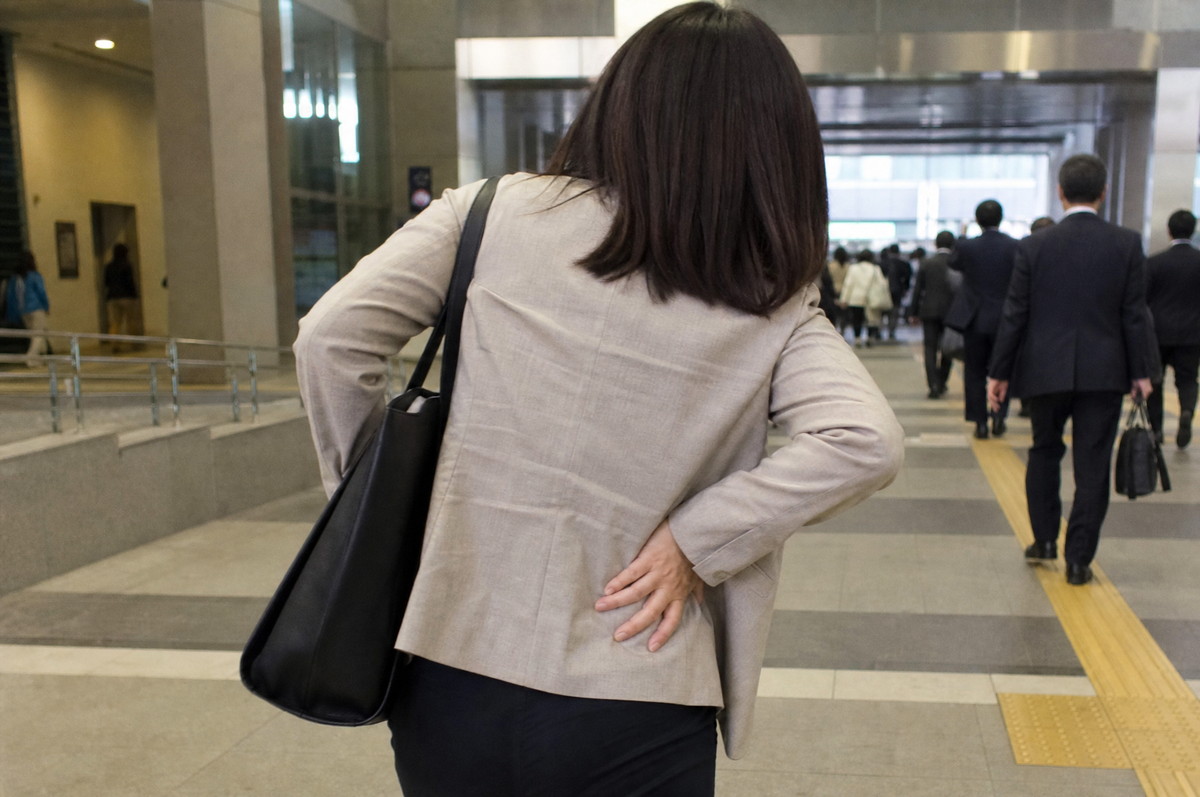
None of these seems to have anything to do with a handbag. That is exactly the point.
- Your lower back aches by mid-afternoon — and you have blamed your chair, your desk, your mattress, or just your age.
- The ache is worse on one side than the other.
- You carry the same bag, on the same shoulder, five days a week — without even thinking about it.
- Your bag is heavy because it has to be: laptop, charger, water, shoes, makeup, snacks. It's basically your whole office.
- Your work clothes have no real pockets, so everything you own lives in that bag.
- Some days one bag isn't enough, so you carry two — a tote and a laptop bag — both on the same side.
- Without deciding to, you sometimes move the bag to the other shoulder, because one side just "feels better."
If you ticked even two, keep reading. Two years ago I would have ticked every single one — and still sworn the problem was my mattress.
I was wrong. So were the people I paid to tell me. And the reason the pain went on so long is the same reason it is dangerous: nothing on that list points at the thing causing it.
My friend asked: "Which shoulder do you carry that bag on?"
The same one. Every day. For years. I never thought about it — it was just the side that felt natural.
Then she explained what no doctor had. When you hang a heavy bag on one shoulder, your body cannot stay straight. To stop you from tipping over, the muscles down one side of your lower back have to pull hard — and they have to keep pulling the entire time you carry it. There is a deep muscle that does most of this work. It runs from your bottom rib to your hip, and its job is to keep you level.1
Carry a load on one side for hours a day, five days a week, and that one muscle never gets to rest. It stays tight. It gets overworked. And it starts to ache — low, deep, and always on the same side.2 That was my ache. Not my mattress. Not my age. A muscle that had been holding me up against a weight I put on the same shoulder every morning.
Here is the part that made me feel sick. It's like carrying a heavy grocery bag in one hand — and never being allowed to set it down. You would expect that to hurt. We just don't expect it from a handbag, because the bag feels light when we pick it up. It isn't light after eight hours. And it isn't light after two years.
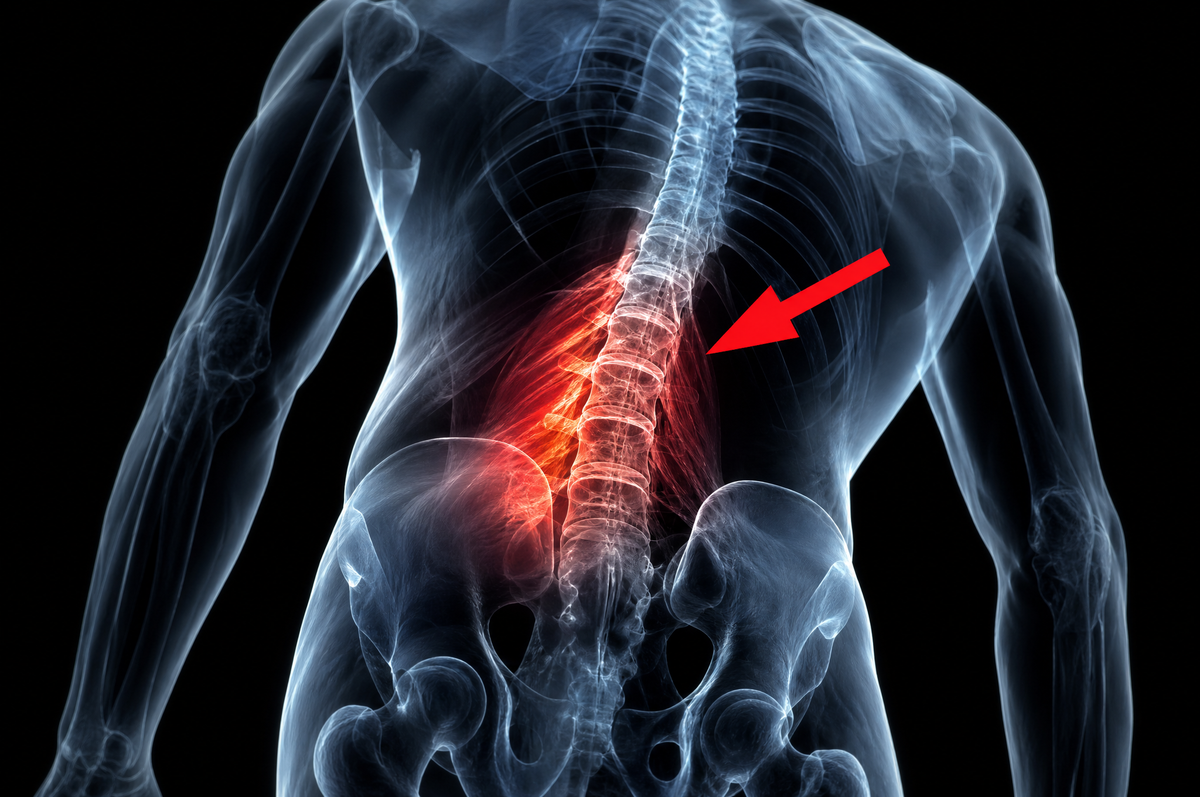
It is common enough that therapists have a name for it: "heavy-purse syndrome." And the reason it fools so many women is exactly what fooled me — the pain shows up in your back, nowhere near the shoulder doing the carrying.3 Once someone explains it, you can't stop seeing it: women on the train standing slightly crooked, one shoulder higher than the other, a hand pressed to one side of the lower back.
And here is why I am begging you not to ignore it.
A tight, overworked muscle is the early stage — the stage where you can still fix it for free, just by changing how you carry. But your body does not stay at the early stage. Keep loading one side, day after day, and it slowly learns the crooked shape. One hip sits higher. Your pelvis tilts. One side stays short and tight while the other stays weak — and that pull does not stop at the muscle. It drags on your spine. Year after year, the discs on the squeezed side wear faster.4
This is the part my friend made me understand. There is a line, and you cannot see it coming. On one side of it, this is a tired muscle that rest can heal. On the other side, it is a worn spine — and a worn spine does not heal back. That's the version with the MRI, the cortisone shots, the specialist who says "we can manage it" instead of "we can fix it." That's the woman who can't lift her own toddler without planning it first, who lies awake doing the math on whether she can afford to take leave.
I am not telling you that to scare you. I am telling you because for two years I sat on the safe side of that line and had no idea — and the only thing standing between me and the other side was a bag I put on the same shoulder every single morning. You don't get a warning when you cross. You just stop being able to go back.
I sat there feeling two things at once. Anger, at two wasted years and the money that went with them. And, to my surprise, relief — because it was never that I was getting old, or falling apart. It was the bag.
And not even my bag, exactly. It's that almost every work bag is built the same way it was thirty years ago: one strap, made to hang off one shoulder. They sell you something lovely and let your back pay the bill. It was never your body that failed you. It's a bag built to be carried the one way that hurts you.
That is also why nothing I tried had worked. The mattress, the cushion, the physio — every one of them treated the pain. Not one of them touched the cause. It was like mopping the floor while the tap was still running. Every single morning, I picked the bag back up and put it on the same shoulder.
That was my first thought too. Carry less. But here is the trap every working woman is in, and maybe you'll recognize it.
Men drop their wallet, phone, and keys into their trouser pockets and walk out the door. Our clothes don't have real pockets — the ones they sew into women's work trousers barely fit a hand, let alone a phone. So everything we own has to go somewhere. And that somewhere is the bag.
So the bag becomes a portable office. Mine held a laptop, a charger, a water bottle, a makeup bag, a pair of flats for the walk to the station, snacks, and a cardigan for the freezing meeting room. None of it is optional. It's the kit you need to get through a workday and still look pulled together. On the heaviest days, it all didn't fit — so I carried a second bag too. Both on the same shoulder.
And here is the part most of us would never say out loud. It was never really about comfort. A man can throw a backpack over his suit and nobody blinks. A woman walks into a client meeting and her bag gets read in half a second — polished and in control, or off-duty and not quite serious. The bag is part of how we get taken seriously. So switching to a backpack doesn't feel sensible. It feels like showing up looking like — in one woman's words I read online — "a lost college kid," or "like I'm going to high school." And the plain, sensible ones just read mumsy. After years of being judged on how put-together you look, you would rather your back pay the price than walk in looking less than you are. That, if I'm honest, is the real reason the bag never changed.
The bind, in one sentence.
You can't carry less, because your clothes give you nowhere else to put it. And you can't carry a backpack — the one thing that would save your back — because you have to walk in looking like you belong in the room, not like you're off to a lecture. So you keep loading one shoulder, every day, and quietly pay for it.
So I went looking for a way out — a bag that would take the weight off one shoulder without making me choose between my back and looking professional. Everything I tried made me give up one or the other.
The orthopedic backpack the wellness blog swore by — kinder to my back, yes, but I'm 42 and walking into client meetings, and it made me look like I was heading to class. I wore it twice. The "sensible" canvas tote — still one strap, still one shoulder, same problem in a new color. The cheap "convertible" bags on Amazon — thin cord straps that dug in worse, and they looked exactly as cheap as they were. Every one of them asked me to give up either my back or the way I look walking in.
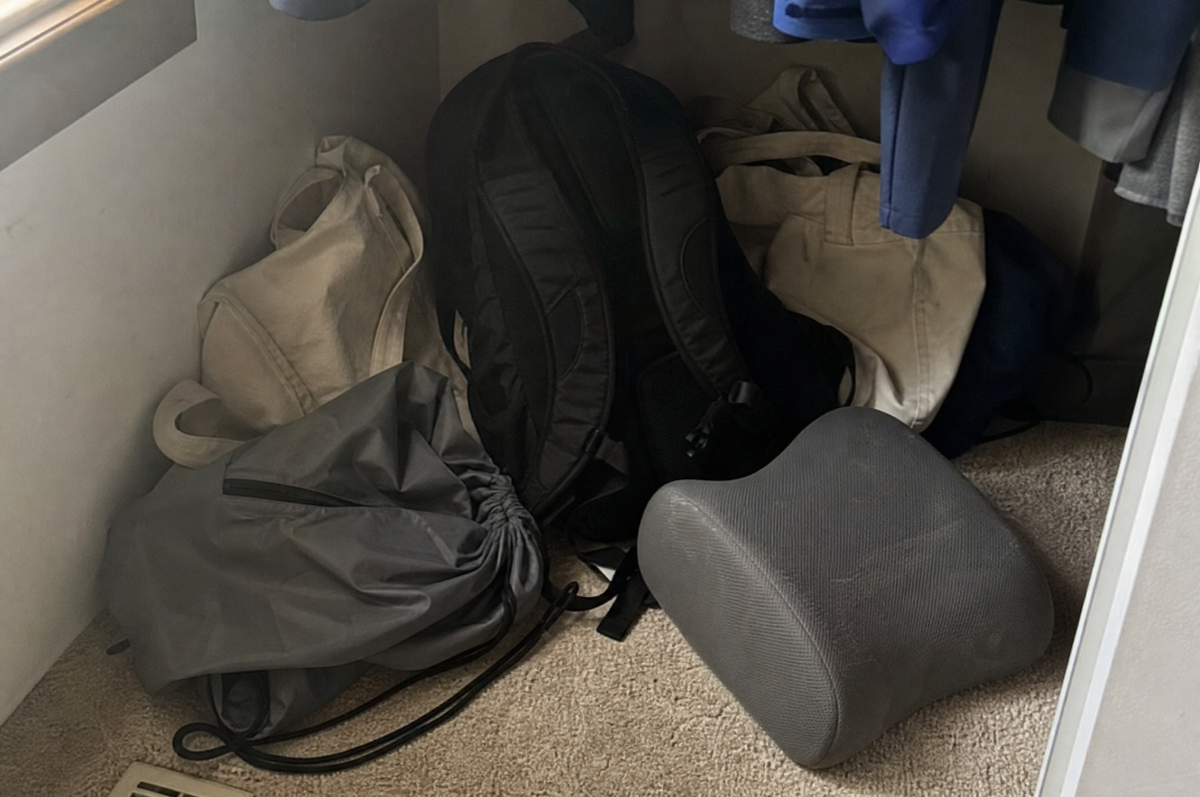
By the end I had accidentally written a checklist — the spec for a bag that would actually fix this:
What a work bag has to do to take the load off — all four, or it's pointless:
1. Come off the single shoulder — let you share the weight across your body or your back.
2. Still look chic and professional — as polished as the shoulder bag I carry now, because I am not willing to trade looking put-together for comfort.
3. Hold your whole day — laptop, water, the lot — so you're never forced to add a second bag.
4. Not look "orthopedic" or like a student's rucksack — or it just lives in the closet, the way my backpack did.
Miss any one of the four, and you're right back where you started. I had written a spec for a bag that, as far as I could tell, didn't exist.
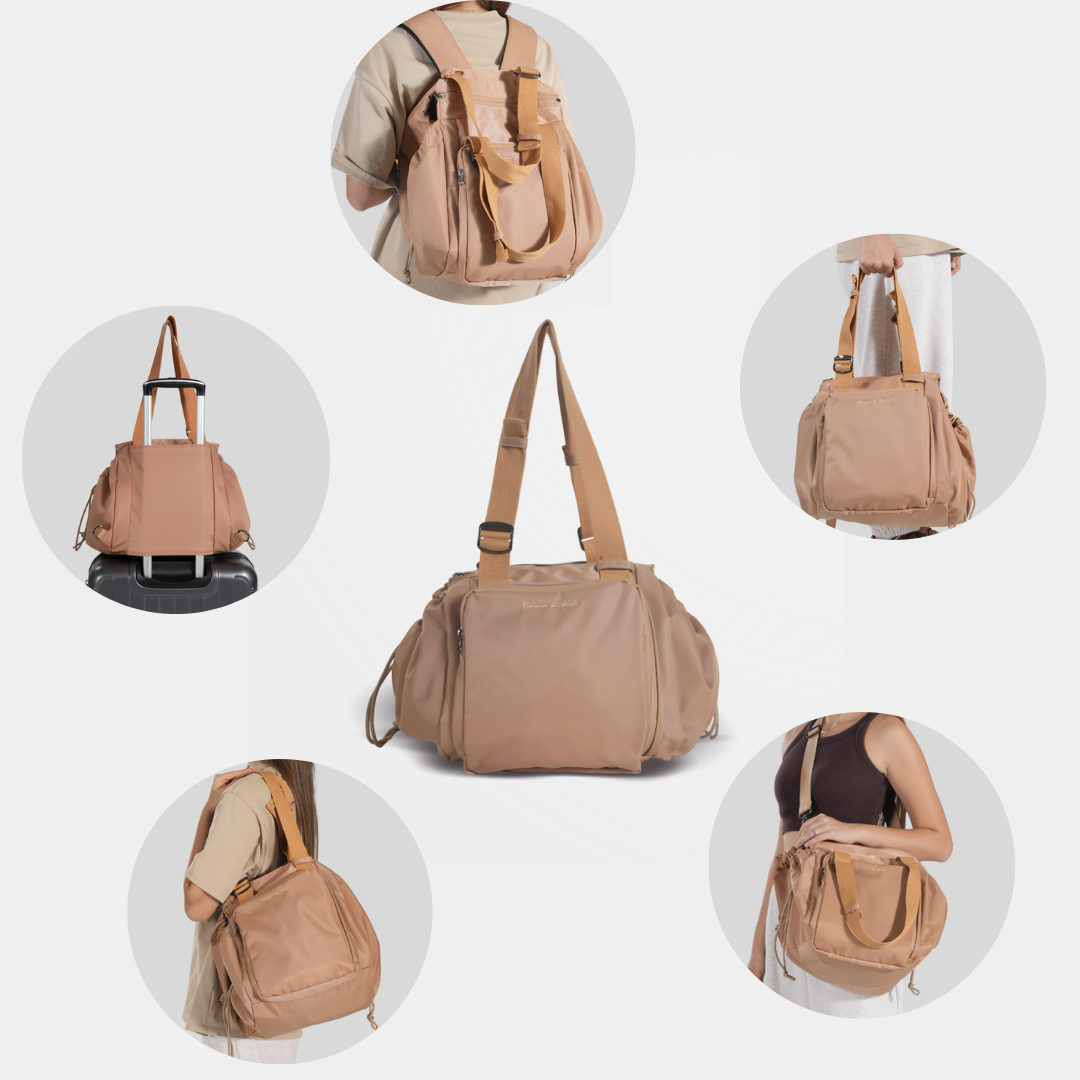
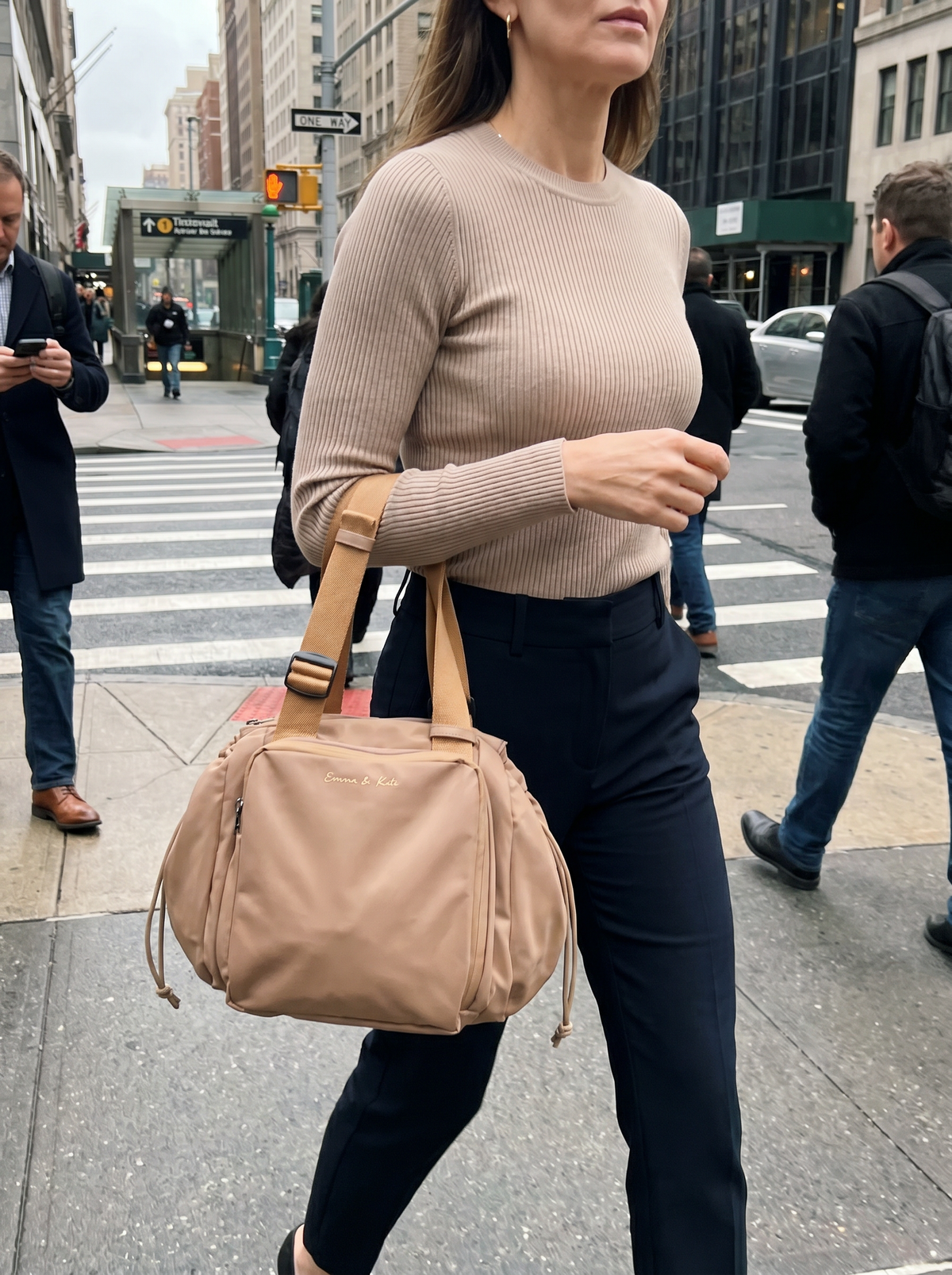
It's the Emma & Kate Everyday Bag, and the whole point is that it doesn't make you choose. It wears five ways. On a heavy day I wear it as a backpack, so both shoulders share the weight evenly — exactly what my friend said my back needed. On a lighter day I wear it over the shoulder and still look completely put together for the office. There's also a crossbody mode that spreads the load across me, a quick hand carry, and a strap that slides onto a suitcase handle so at the airport I'm not carrying it at all.
The straps are wide and padded — no thin cord cutting in — and they tuck away when I don't want them showing. And it expands: pull the side drawstrings and it opens wide enough to hold my laptop, charger, water, flats, and the cardigan — so I am never tempted to sling a second bag onto the bad shoulder again.
And here's the part I didn't expect to love. Inside there are up to 15 pockets and compartments, so everything has its own spot. No more digging to the bottom of a black hole for my keys. There's even a one-handed pull-open at the top — so I can grab my phone on the train without setting the bag down or rummaging through it.
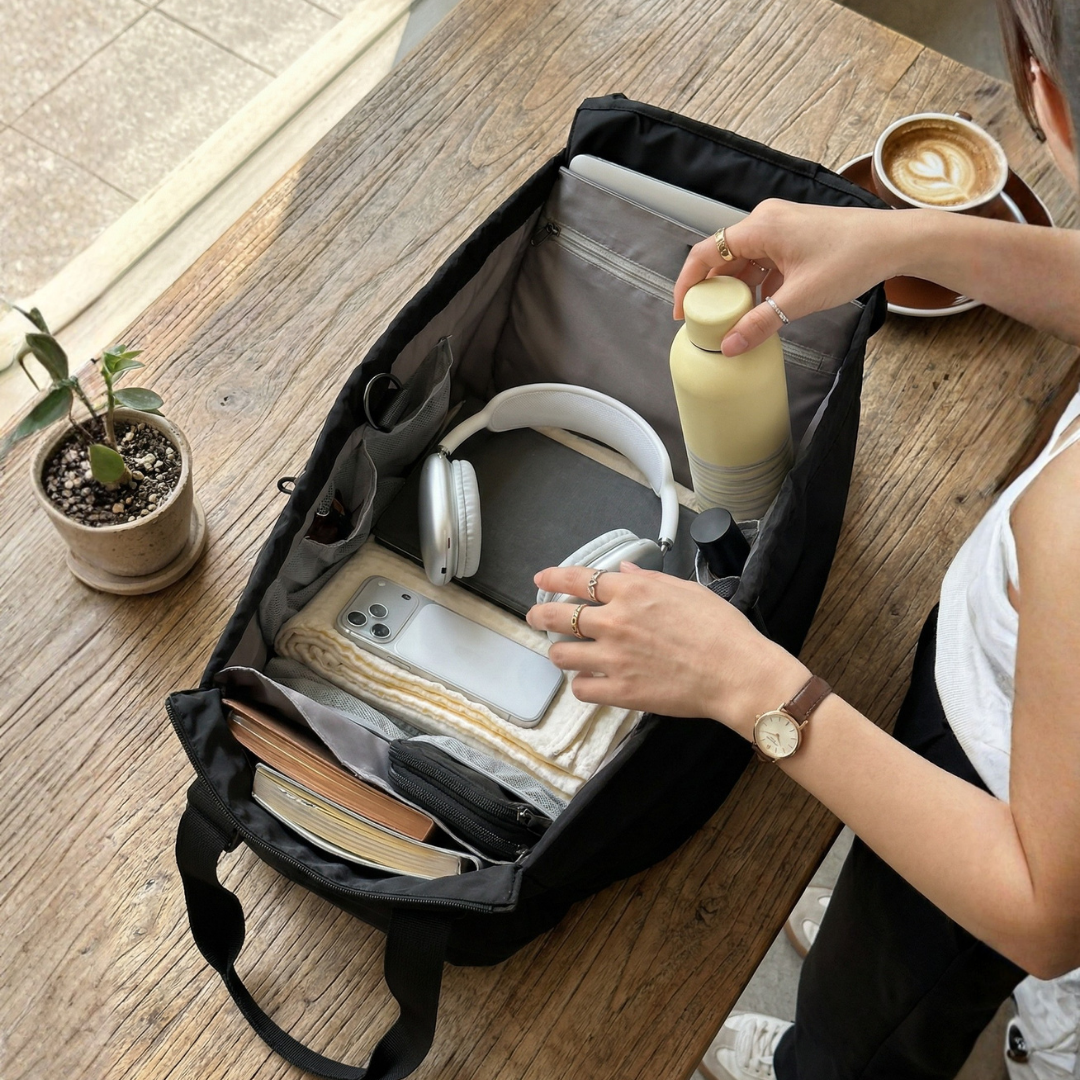
The first morning I wore it as a backpack, I braced out of habit — waiting for the three o'clock ache. It didn't come. Not that afternoon. Not the next one. For the first time in two years, I got through a full workday and simply forgot about my back — which was the whole point.
A stranger online had described my exact search before I ever found mine:
I'm a tote girl at heart, so I wanted something convertible. Padded straps that tuck away. And dare I say it — it looks chic. When I wear it as a backpack it doesn't make me look like a turtle. I've even had compliments. — a woman describing her own search
If you want to see it, here's the exact bag from the story — five carry ways, up to 15 pockets inside, and it holds a whole work day without wrecking your shoulder.
Check if it's in stockThe first week, I kept reaching to switch shoulders on the platform — but there was nothing to switch. So I just kept walking.
By the second week, the ibuprofen I kept in my desk drawer for the three o'clock ache sat untouched — so I stopped restocking it. By the fourth week, I realized I had stopped bracing for the afternoon at all. The deep ache on my left side, the one I'd carried for so long, had quietly faded into the background.
By the second month a colleague tilted her head and said, "You look different — did you do something?" I had. I'd simply stopped wrecking one side of my body every day on the way to work. And in the next group photo, I wasn't the one standing slightly crooked.
| E&K Everyday Bag | "Cute" one-strap tote | Orthopedic backpack | |
|---|---|---|---|
| Comes off the single shoulder | ✅ five ways | ❌ | ✅ |
| Wide padded straps | ✅ | ❌ thin cord | ✅ |
| Holds your whole day | ✅ expands | sometimes | ✅ |
| Looks polished at work | ✅ | ✅ | ❌ like a student |
Every other column forces a sacrifice. There's exactly one with no ❌.
So many of you have written in asking which bag this is. Here it is — same one, in five colors.
See current availabilityI'm not going to tell you a bag is medicine. It isn't, and anyone who says so is lying to you. But here's the truth: when I finally took the weight off that one shoulder, the ache that two years of treatments never touched started to ease. For the first time, I had fixed the cause — not just covered up the pain.
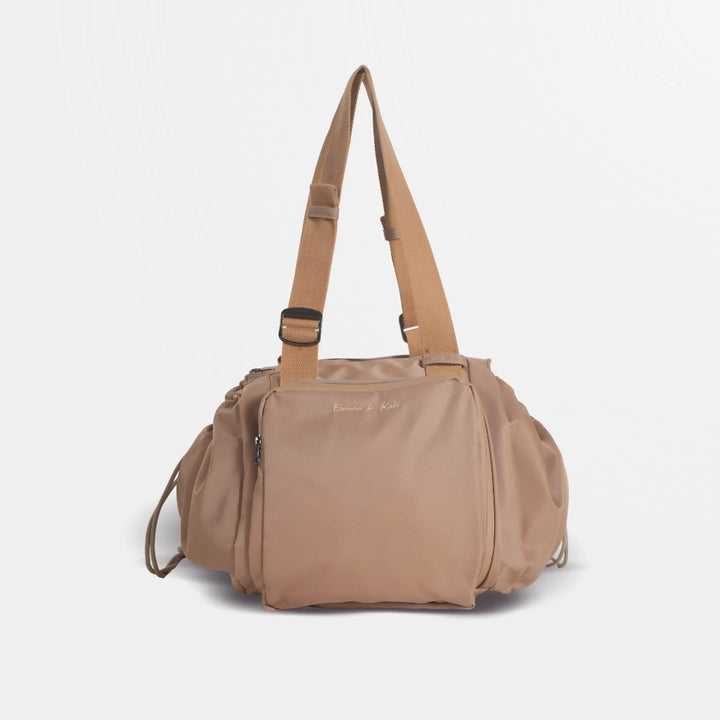
If you want to look it up, it's the Emma & Kate Everyday Bag. It comes with a 90-day guarantee — which, honestly, was the only reason I let myself try one more thing after everything I had already wasted money on. It took away the risk of being wrong again.
If I were you, I'd check what's in stock before you decide — the colors don't always all stay available.
Check current availabilitySo go back to that checklist at the top. If you ticked two, or three, or more — please don't do what I did and blame your chair, your mattress, or your age. Those weren't my problem. And "it's just getting older" is exactly the story that cost me two years.
I caught mine while it was still just a muscle, before it set into something worse. You can too — but the time to do it is while it's still just an ache.
Here's the math that finally scared me into acting.
Changing the way you carry costs you almost nothing today. But a worn-down spine does not stay cheap. Picture the other side of it: an MRI, a specialist, months of physical therapy, maybe time off work you can't afford to take. That bill runs into the thousands — and some of that damage never fully heals.
The damage from one shoulder is slow and quiet — a muscle pulled a little tighter, a hip sitting a little higher — until one day the ache stops going away on its own. You don't get a warning when that day comes. I waited two years and spent over $2,000 chasing the wrong fix. Please don't give it the chance to cost you far more than that.
That's my whole story. If even half of it sounded like you, this is the bag I'd hand you in person.
Check availability & today's price →— Rachel M., as told to The Wellness Edit
References
- The quadratus lumborum runs from the lowest rib to the pelvis and stabilizes the spine against side-to-side loading; a common source of one-sided lower-back pain. [SLOT: cite — Cleveland Clinic; Kenhub]
- Asymmetric one-sided loading overworks the muscles on one side of the lower back and is linked to chronic strain over time. [SLOT: cite — Houston Neurosurgery & Spine]
- "Heavy-purse syndrome" — handbag-related strain whose symptoms often appear in the back, away from the shoulder. [SLOT: cite — Freedom Physical Therapy; Chatelaine]
- Prolonged asymmetric loading is associated with postural imbalance that can contribute to longer-term spinal problems. [SLOT: cite — peer-reviewed posture/loading source]
ADVERTISEMENT. This is an advertisement and not an independent news article or editorial. The account is a customer story shared with permission; individual results vary and are not guaranteed. This page may receive compensation when you purchase through links above. "Rachel M." / "The Wellness Edit" are presentation devices for this advertisement. Emma & Kate does not make medical claims; this product is a bag and is not intended to diagnose, treat, cure, or prevent any condition.
